#Claude Code
8 expert briefs on Claude Code, from videos, podcasts and documents.
What the sources say
These sources explore how users combine Claude Code with external tools, knowledge graphs, and structured environments to automate complex tasks in software development, sales, and knowledge management.
Several speakers agree that Claude Code performs best when paired with external structures rather than operating alone[1][2][3][4][5]. Jamie and Chase note that traditional retrieval methods reset on every query, so they recommend using Obsidian or knowledge graphs to build a persistent memory[1][3]. Jack introduces Graphify to solve the rereading tax[2]. Similarly, Matt argues to David that developers should focus on this surrounding harness instead of obsessing over new models[5].
The analyses differ in their specific applications of the AI. While Chase focuses on a backend operating system for coding[4], sales developers show how to use the Model Context Protocol in the Cursor environment to automate cold email campaigns[6][7]. A reader can take away that artificial intelligence is shifting from simple chatbots to autonomous systems. Ezra Klein and Jack Clark discuss this transition, noting that autonomous coding agents will have profound implications for the labor market and software engineering[8].
Sources
- The LLM Wiki: How to Build an AI Knowledge Base That Never Forgets
- Graphify: Giving Claude Code a "Map" of Your Codebase (And Why It Changes Everything)
- Give Claude Code a "Second Brain": Merging Graphyte Knowledge Graphs into Obsidian
- The Anatomy of an Agentic OS: Why 90% of the Value Is Invisible
- The Harness Over the Model: Why Software Fundamentals Beat Chasing Shiny AI
- 🚀 MASTERING CLAUDE CODE & MCP: The Ultimate Guide to Automating Outbound Campaigns in Cursor
- 🚀 AI-Powered Sales Automation: Configuring Claude Code & Instantly MCP for Instant Lead Gen
- The Age of Agents: Jack Clark on the End of Software, the Rise of AI Employees, and the Crisis of Human Cognition
Written by an AI model from Google, from the analyses on this page.
The LLM Wiki: How to Build an AI Knowledge Base That Never Forgets
Build an LLM Wiki that never forgets: use Obsidian and an AI agent to replace RAG with a self-organizing, persistent knowledge base. Step-by-step for non-coders.
Graphify: Giving Claude Code a "Map" of Your Codebase (And Why It Changes Everything)
Graphify builds a knowledge graph of your codebase to kill Claude Code's 'rereading tax'—cutting tokens, boosting speed, and grounding answers. See how it works.
Give Claude Code a "Second Brain": Merging Graphyte Knowledge Graphs into Obsidian
Turn any repo into a queryable knowledge graph and fold it into Obsidian so Claude Code gains a 'second brain.' Full Graphyte + Obsidian setup walkthrough.
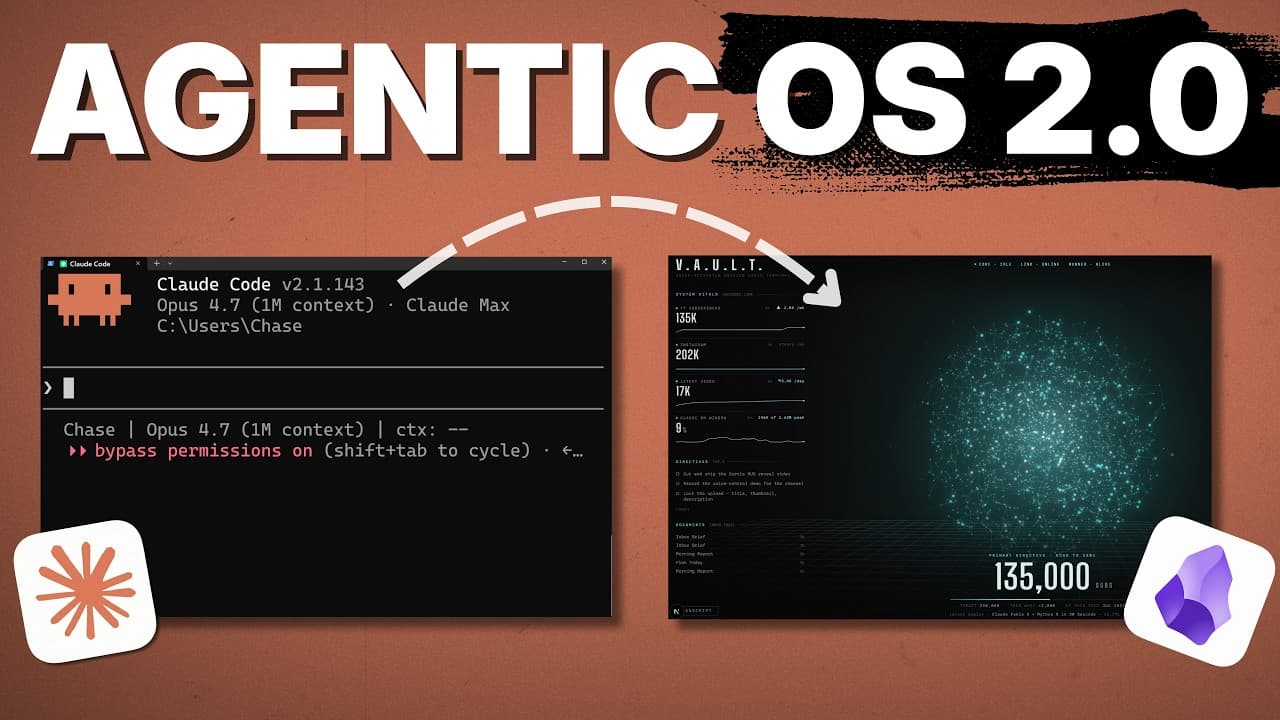
The Anatomy of an Agentic OS: Why 90% of the Value Is Invisible
90% of an Agentic OS value hides in the backend, not the dashboards. Learn the 4-level Claude Code stack: skills, memory, loop engineering, and second-brain design.
The Harness Over the Model: Why Software Fundamentals Beat Chasing Shiny AI
The harness beats the model in AI coding: Matt explains why prompts, skills, and codebase architecture matter more than chasing the latest shiny AI model.
🚀 MASTERING CLAUDE CODE & MCP: The Ultimate Guide to Automating Outbound Campaigns in Cursor
Master Claude Code and MCP in Cursor to automate outbound campaigns. Learn to streamline sales workflows with Instantly.ai in this step-by-step guide.
🚀 AI-Powered Sales Automation: Configuring Claude Code & Instantly MCP for Instant Lead Gen
Automate outbound sales with Claude Code and Instantly.ai. Discover how to use MCP and the Cursor IDE to build autonomous lead generation workflows.

The Age of Agents: Jack Clark on the End of Software, the Rise of AI Employees, and the Crisis of Human Cognition
Jack Clark discusses the age of AI agents and the end of software. Learn how Claude Code disrupts labor markets and creates a "Junior Crisis."